MPOB PAC update: From frameworks and compliance to measurement, integration, and real-world decisions.

See Khor Yu Leng’s update on LinkedIn

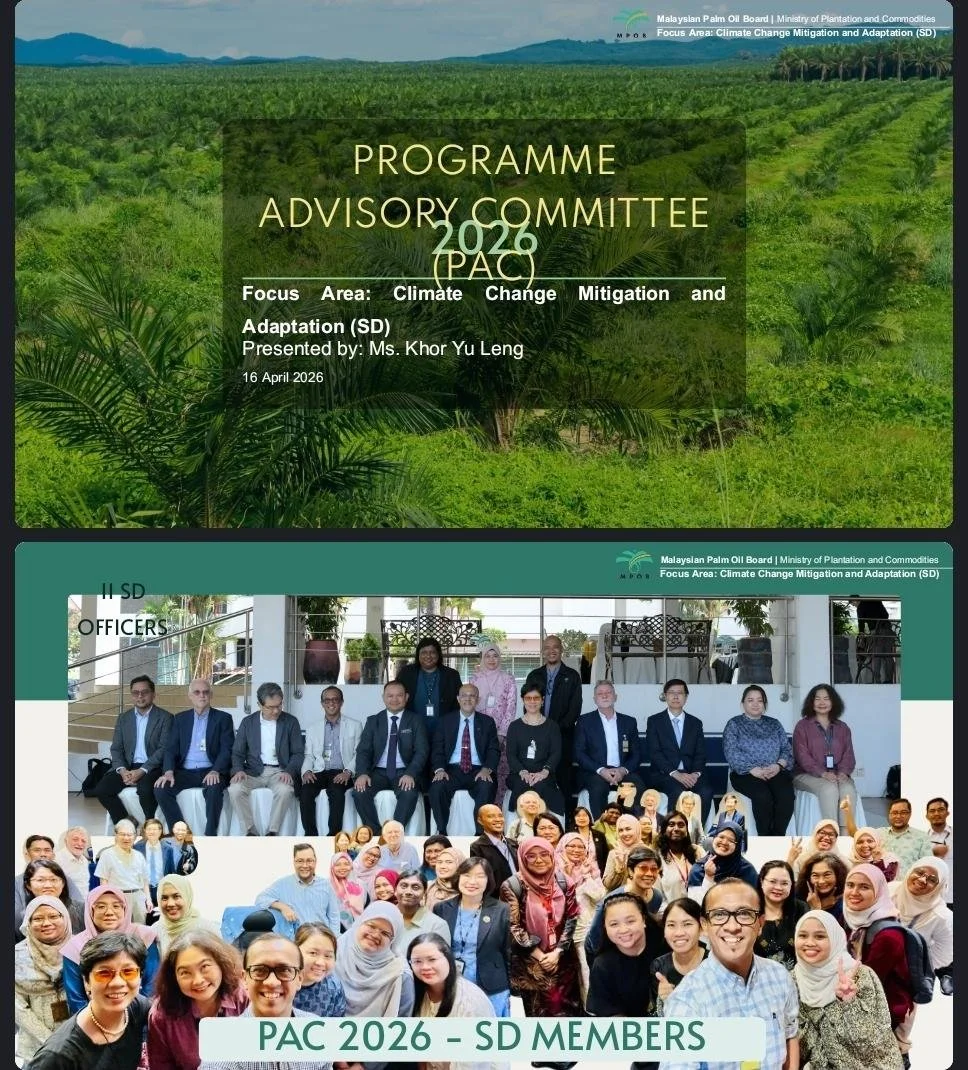
Just wrapped 3.5 intense days at the Malaysian Palm Oil Board HQ—marking the close of my three-year stint chairing the #ClimateChange Mitigation & Adaptation (aka #sustainabledevelopment) sub-committee under the Programme Advisory Council.

A simple takeaway: the science has moved on. #Sustainability in palmoil is no longer about frameworks or compliance - it is about measurement, integration, and real-world decisions. The research teams are stepping up: stronger capabilities, deeper field work, and an encouraging ability to innovate under real plantation constraints. What stood out most was not just the data, but the spirit of the researchers - practical, adaptive, and increasingly systems-focused, led by Meilina Ong-Abdullah, Dr. Vijaya Subramaniam, mohd hefni Rusli, Kamil Azmi Tohiran, Zaki Aman, Rafidah Abd Hamid, Nor Hasbira Hasbullah, Wan Aina Farhana.

Under the leadership of Ahmad Parveez Ghulam Kadir, the next wave of #yield actualization has taken shape - driven by MPOB’s genomic advances, particularly on the #shellgene to eliminate ultra-low-yield planting material. At the same time, the industry is beginning to grapple with the role of #DNAtesting in enabling wider adoption of #clonal planting material.

Across biodiversity, soils, water and climate, the conversation has clearly shifted. The challenge is no longer identifying issues - it is connecting them. #Watersystems linking to yield and emissions. #Soilbiology linking to carbon and productivity. #Biodiversity linking to #pestcontrol and landscape resilience. #Climaterisk cutting across all of it. In short: from siloed projects to integrated systems thinking.

The next frontier is clear - turning this into decision tools. Spatial mapping, data integration, and partnerships that bring in estates, smallholders, more research institutions and increasingly, finance. This is where agencies like MPOB have a unique role - not just as a research body, but as a platform to unlock value from sustainability.

A personal note: it has been a privilege to work with a deeply committed team over these years. The capability is there. The question now is speed, focus, and execution.

Congratulations to Mohamad Helmy Othman Basha (HOB) on a second consecutive appointment, allowing him to build on the momentum of his MPOB Chairman role.

Bottom line: The future of oil palm will not be judged by what we say about sustainability - but by how well we measure it, integrate it, and act on it.

Our members
Ms. Khor Yu Leng (Segi Enam Advisors Pte Ltd)
Mr. Ho Shui Hing (United Plantation Berhad)
Prof. Dr. Simon Lord (Simon Lord Consultancy)
Mr. Rashyid Redza Anwarudin (SD Guthrie Berhad)
Prof. Dr. Takashi Hirano (Hokkaido University)
Ms. Marcie Elene Marcus Jopony (IDH)
Datuk Dr. John Payne (BORA)
Dr. Ahmad Aldrie Amir (Universiti Kebangsaan Malaysia)
Dr. Pankaj Trivedi (Texas Tech University, USA)

Reach us at khorreports@gmail.com for more information!

Market update: Hormuz shock puts biodiesel back in play - but the real opportunity is in the grid

The Strait of Hormuz shock has pushed biodiesel back into the energy security spotlight - but the divergence is telling. I discussed this in a question from China Daily.

Indonesia is executing, moving from B40 toward B50 with a levy-funded system; Malaysia is expanding from B10 (partial B20) but it is constrained by cost and infrastructure at each step; Thailand is cushioning via subsidies and B20, while Philippines remains at B3, relying on fiscal relief.

Malaysia's Felda talks about B100 use on its sites. Market reality check: high diesel prices do not automatically make biodiesel viable. Voluntary CPO-to-diesel switching has only worked a small minority of the past decade, clustered in crisis spikes - not a stable regime. This is a diesel story, not a vegoil story - margins are squeezed by weak feedstock signals and high input costs, limiting substitution. Vegoil is priced (higher) for food and many have reservations about further boosting fuels against food.

Against this backdrop, the more immediate lever in Malaysia and others with palm oil mills may not be higher biodiesel blends - but unlocking distributed energy. Palm oil mills already generate significant biomass power from waste streams, yet remain locked out of local grids by utility structures and pricing barriers. With rural areas still reliant on expensive diesel and grid expansion costly, enabling embedded biomass generation offers a practical path to resilience.

Biodiesel remains strategically important but structurally constrained. The near-term opportunity is closer to home - use what palm oil already has. Unlocking palm biomass into local grids may deliver more reliable energy security gains than pushing toward higher biofuel blends.

A deep dive into Malaysia’s call for B100

On a news slot for BFM, I discussed how this is strategically appealing but structurally constrained: while it can be produced at ~RM4.5/L and even briefly undercut diesel during oil shock cycles, this advantage is episodic (below 10% of the past decade?) and distorted by refinery-gate vs subsidised pump pricing. Scaling B100 would require diverting ~8–10 million tonnes (40–50%) of Malaysian palm oil, RM5–10bn+ infrastructure, and potentially RM5–20bn+ in subsidies, while current policy (e.g. RM2.15/L diesel in East Malaysia) effectively overrides market competitiveness. Real-world site deployment also remains limited—it appears no/few mining fleets run B100 at scale, with usage usually capped at B20–B50 due to engine, regulatory, and logistics constraints, even in Indonesia where mines are near palm estates. B100 works in short-term arbitrage and pilots, but not as a system-wide fuel solution.

With ongoing energy shocks and rising energy security concerns, it is time to seriously revisit whether palm oil mills in Malaysia should be allowed to export biomass-generated power into local grids These mills already produce significant underutilised energy from waste streams, yet remain largely locked out by utility structures, pricing controls, and interconnection barriers. In a context where rural areas still rely on costly diesel and grid extension is expensive, enabling embedded generation from palm biomass could provide reliable, localised, and lower-cost power. The question is no longer technical—it is policy: whether Malaysia is ready to unlock distributed energy from an existing asset base to strengthen resilience.

Reach us at khorreports@gmail.com for more information!

Bloomberg Feature - Prolonged dry season, elevated hotspots and haze concerns

Fire hotspots across Indonesia and Malaysia have hit a seven-year high for the month of March, with 825 smoldering sites recorded across key palm-oil growing regions - a sharp early-season signal that the region faces serious haze risks in the months ahead.

Segi Enam Advisors’ Principal Khor Yu Leng was quoted in Bloomberg's coverage of the crisis, describing what the data signals about the changing nature of the risk:

"This points to a structural shift, where fire and haze risks are no longer confined to the main dry period but increasingly extend into off-season windows due to prolonged dryness."

- Khor Yu Leng, Principal, Segi Enam Advisors

The warning comes as below-normal rainfall continues across Sarawak, Johor, Sumatra, and parts of Kalimantan. Forecasters expect arid conditions to persist through August, raising the prospect of a crisis comparable to the 2015 regional haze emergency, which caused an estimated USD16 billion in damages.

Singapore has already recorded unusually early haze impacts - months ahead of the typical August–November peak season.

For a better understanding of recent fire events, haze incidences and unseasonal prolonged dry weather, read our insights on the Johor January fires here.

Reach us at khorreports@gmail.com for more information!


Khor Reports: Global Fire Weather Is Rising - But Equatorial Southeast Asia Is Bucking the Trend

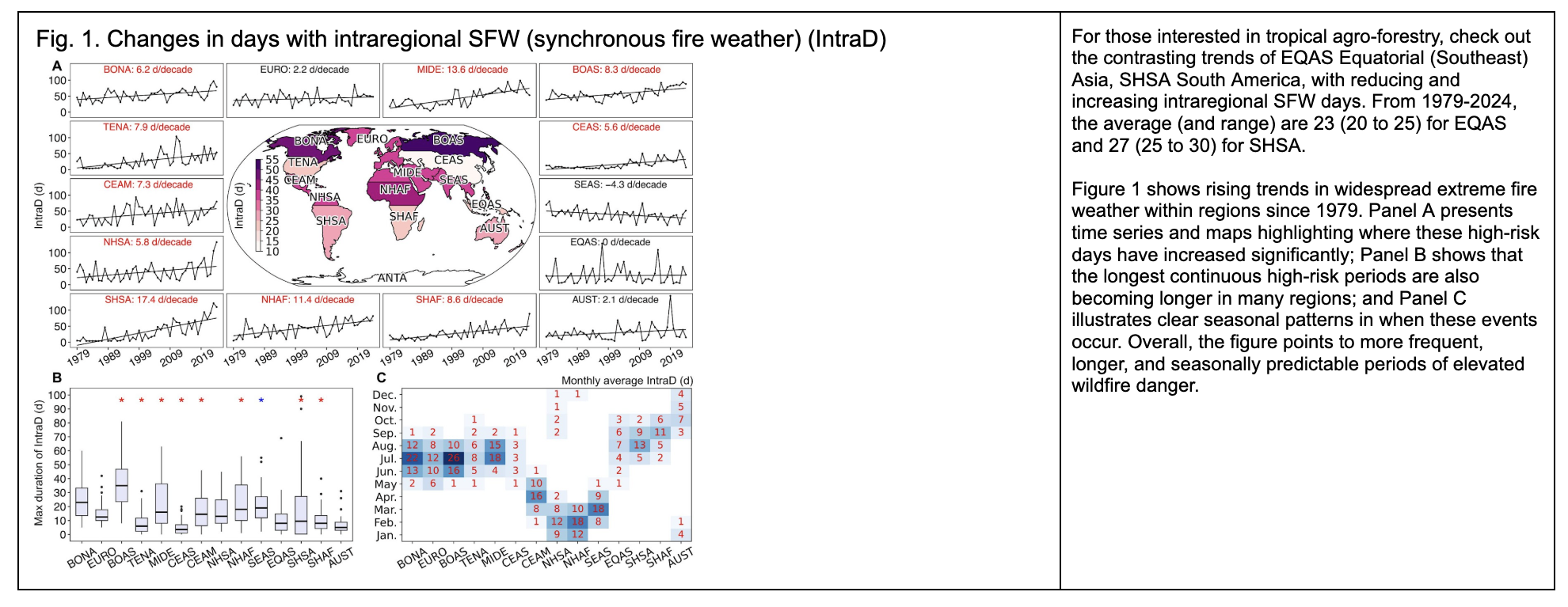
Watch out for synchronous fire weather days, which can sharply increase major wildfire risks. I’ve been tracking this for over a decade, and earlier research highlighted a key uncertainty in climate modelling: cloud cover over equatorial regions. This new work adds useful detail for those of us in #SoutheastAsia, especially in understanding rising atmospheric humidity, cloud formation, and associated flood risks. Several studies help support the view that atmospheric humidity and moisture‑related extremes are changing over Southeast and equatorial Asia, even as cloud feedbacks and moisture patterns remain areas of model uncertainty.

“Increasing Synchronicity of Global Extreme Fire Weather” by Yin et al. (2026) notes that concurrent extreme fire weather can enable widespread large fires, strain firefighting coordination, and degrade air quality. The study finds elevated synchronous fire weather in boreal regions and strong interregional links across northern temperate zones, with a more than twofold rise in many regions from 1979 to 2024 - over half attributable to anthropogenic climate change. South America shows the largest increase, linked to warming and drying, while tropical regions such as Equatorial (Southeast) Asia show declining trends, likely due to increased atmospheric humidity. Extreme fire weather-marked by dry, windy, and warm conditions-heightens ignition risk and fire spread.

Importantly, climate variability such as the El Niño–Southern Oscillation (#ENSO) significantly amplifies fire risk, bringing around 43 additional high-risk fire weather days to Equatorial Asia during El Nino years and increasing fire-related PM2.5 pollution and health impacts. At Khor Reports – Segi Enam Advisors, we have worked with colleagues at Singapore Institute of International Affairs on annual Haze Outlook reports since 2019 - do check them out ( 2025, 2024, 2023, 2022, 2021, 2020 and 2019). We are currently preparing the 2026 outlook.

Reach us at khorreports@gmail.com for more information!


Khor Reports: Johor’s January wildfires affect Singapore air quality. Watch for offpeak risks?

By Khor Yu-Leng, yuleng@segi-enam.com

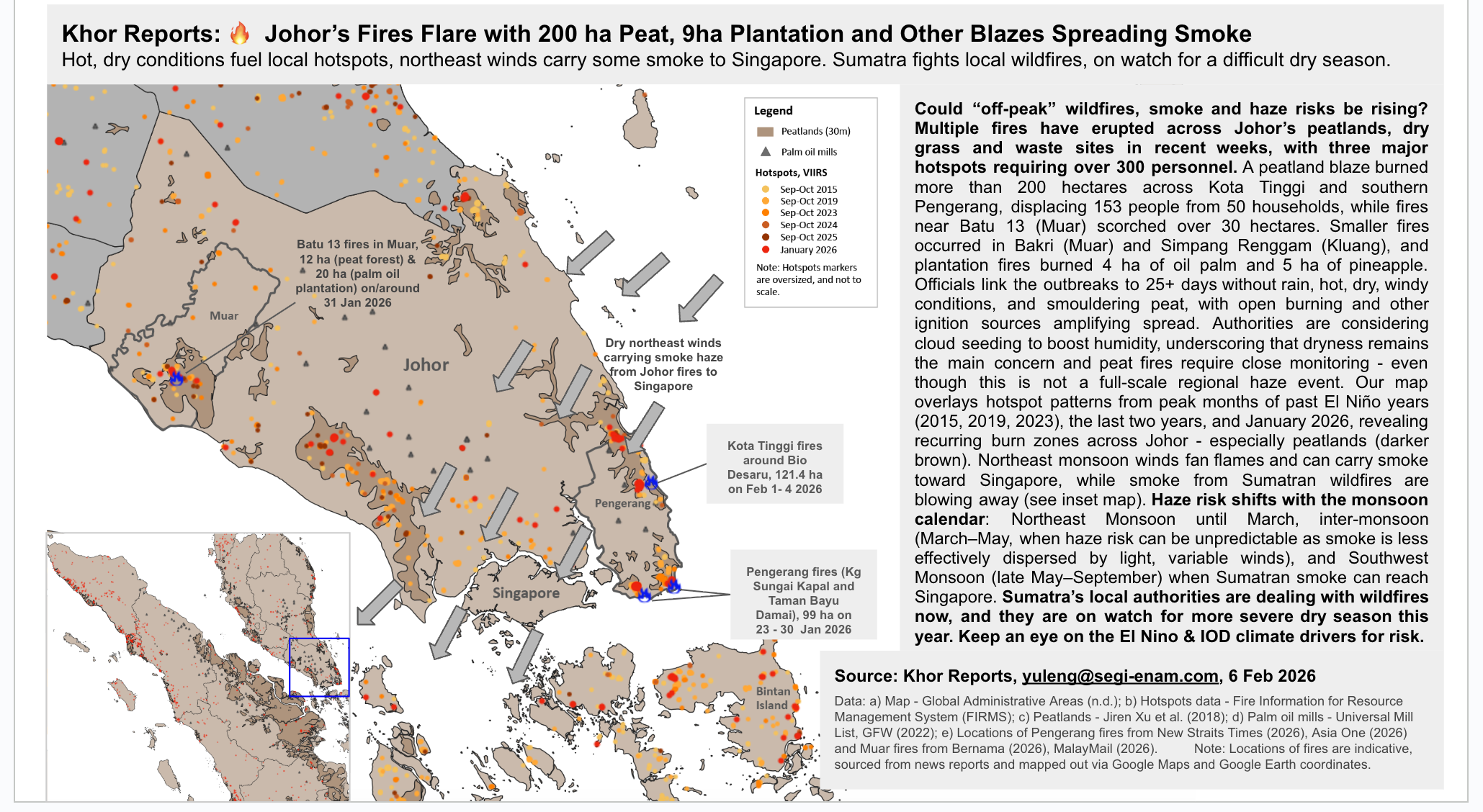
Multiple fires have broken out across Johor’s peatlands, dry grass and waste sites in recent weeks, with authorities battling three major hotspots and deploying more than 300 personnel. A large peatland blaze near Pengerang forced evacuations and blanketed nearby communities in thick smoke.

The fires were primarily linked to prolonged hot, dry and windy conditions which desiccated peat soils and vegetation - creating ideal conditions for rapid spread and making suppression harder. Authorities have also flagged heightened open-burning risks, while regional data shows fires often originate from dumpsites, farms, plantations, orchards and industrial areas. Northeast monsoon winds are currently fanning flames and, at times, can carry smoke toward Singapore. However, these wind patterns are preventing transboundary haze risks stemming from ongoing Sumatran wildfires. See our map below for more context.

This weather-driven but human-amplified fire episode is shaped by short-term drought rather than El Niño-scale forcing. Still, the risk profile resembles early dry-season dynamics - peat ignition, fire-prone agricultural edges and wind patterns influencing cross-border haze - and warrants close monitoring, even if this is not yet a structural regional haze crisis. Makes us question - are “off peak” wild fire haze smog risks rising? 


Reach us at khorreports@gmail.com for more information!

Khor Reports - PalmTrack’s Info Brief on Cyclone Senyar and Sumatran Agroforestry - Blame and revocations fall on pulp, logging and others

By Khor Yu-Leng, yuleng@segi-enam.com

Cyclone Senyar, which struck Sumatra in late November 2025, exposed how upstream watershed land-use decisions can sharply amplify disaster risk. Extreme rainfall interacted with degraded forests and fragmented concessions, worsening floods and landslides across Aceh, North Sumatra and West Sumatra. The human cost was severe, with hundreds killed, hundreds more missing, millions affected and large-scale displacement of communities, particularly in flood-prone and deforested watersheds.

Post-disaster audits concluded that environmental degradation within industrial forestry, mining and infrastructure concessions materially intensified runoff, sediment flows and debris movement. Authorities linked these land-use failures directly to downstream destruction, marking a shift toward holding companies accountable not only for regulatory breaches but for their contribution to disaster impacts.

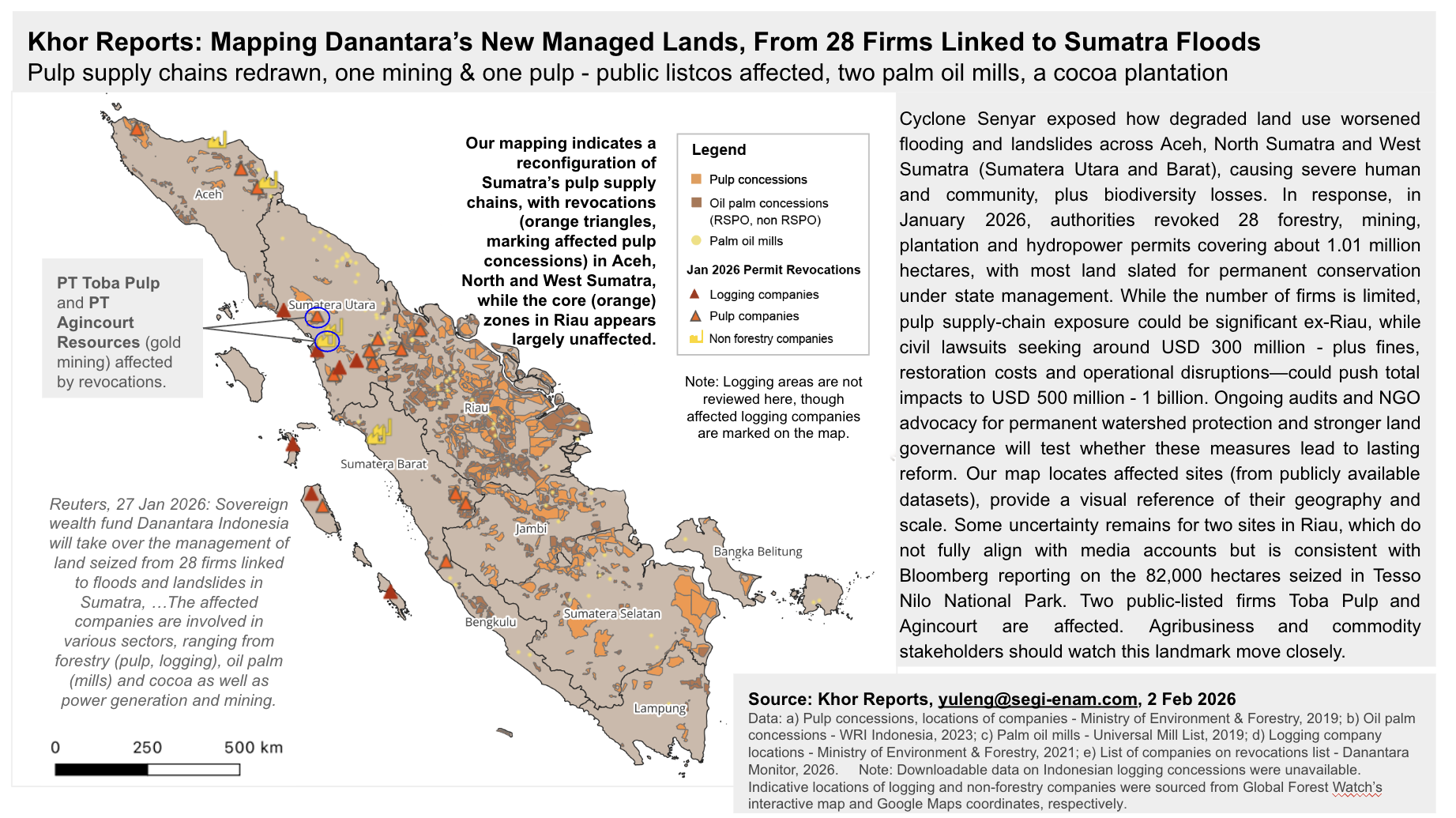
The fallout is now reshaping pulp supply chains: our mapping analysis (see below) shows disruption concentrated in Aceh, North Sumatra and West Sumatra, while the core pulp zone in Riau appears largely unaffected, raising questions around fibre sourcing, logistics and compliance for operators outside Riau, many of whom come under Danantara Indonesia’s umbrella.

The government response has been significant. 28 permits across forestry, mining, plantation and hydropower operations - covering about 1.01 million hectares - have been revoked, with around 900,000 hectares slated for redesignation as permanent conservation forest. Management of seized land will be transferred to the state-linked entity Danantara, tasked with preventing re-occupation while limiting social disruption for affected workers and communities.

Financial and operational pressures are building. Civil lawsuits seeking roughly IDR 4.8 trillion (around USD 300 million) in environmental damages are underway, with combined exposure from fines, restoration obligations, suspended permits and reputational impacts potentially reaching USD 500 million to USD 1 billion. Authorities say audits will continue, while NGOs are calling for permanent protection of high-risk watersheds, greater transparency in concession ownership and large-scale restoration to reduce future disaster losses.

Note on palm oil. Our assessment broadly aligns with available reports, and the overall impact of Cyclone Senyar on Sumatra’s oil palm sector appears to have been limited compared with the severe disruption seen in upland forestry and watershed areas. While the cyclone caused severe flooding and landslides in Aceh, North Sumatra, and West Sumatra, most large oil palm plantations in lowland and coastal zones were relatively spared. Smallholder communities in some areas, particularly Aceh, suffered catastrophic home losses, but core estate operations remained largely intact. Disruptions were primarily logistical, with temporary road blockages and minor water damage to offices and warehouses; fresh fruit bunch deliveries generally resumed within 5–10 days. Overall, regional palm oil output dipped by less than 5% (≈100,000–200,000 tonnes), a modest impact compared with pulpwood, timber, and upland forestry losses. Observers noted the sector’s resilience, while highlighting the need for targeted support for affected smallholders.

Reach us at khorreports@gmail.com for more information!

Updates from the 21st Indonesia Palm Oil Conference

The 21st edition of the Indonesia Palm Oil Conference was held in Bali from November 12th to 14th, under the theme “Navigating Complexity, Driving Growth: Governance, Biofuel Policy and Global Trade.

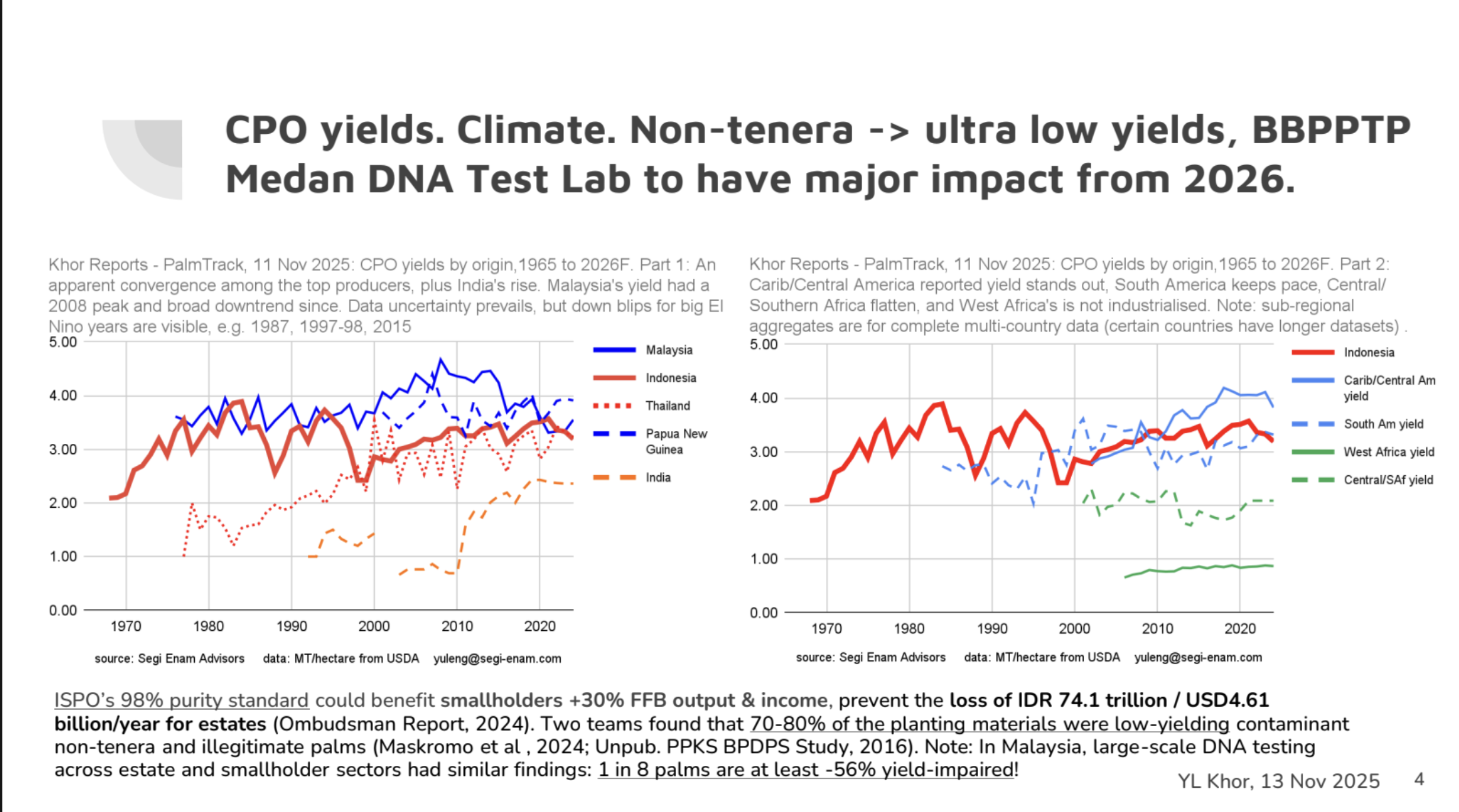
Our director, Ms Khor Yu-Leng, spoke on the first panel, where she scrutinised palm oil yields (across global regions between 1967-2026F - see chart below), doubling smallholder incomes and having the local data to do so. She stressed that “this is the medium and long term necessity for biodiesel, sustainability and social justice”.

Suggesting improvements to current yield conditions in palm oil landscapes, Yu Leng suggests identifying sub-district hotspots for targeted interventions, direct financing to areas with highest potential income and yield gains, and empowering evidence-based decision-making.

Further, Yu Leng stressed a climate adaptation backbone moving forward, focusing on i) water managagement, fire and flood monitoring, agroforestry, institutional finance with local co-designing, and ii) integrating adaptation in every step of the biodiesel value chain.

Reach us at khorreports@gmail.com for more information!


Preliminary Note on Malaysia Carbon Tax

By Khor Yu-Leng, yuleng@segi-enam.com,

Malaysia’s planned carbon tax is designed to help achieve its climate commitments, particularly its goal to reach net-zero emissions by 2050, and complement the National Energy Transition Roadmap (NETR) and its evolving fossil fuel subsidy rationalization strategy. The tax aims to kick-off in 2026 for high-emission industries like iron, steel, and energy, and phase to other sectors over time.​

NETR projects, including CCUS, hydrogen, and modern grid initiatives, are expected to further cut residual emissions, especially in hard-to-abate sectors. But it is widely acknowledged that Malaysian scientists are skeptical of CCUS, a significant part of the strategy. Will Malaysia’s carbon tax have to bear more of a burden if NETR projects fall short? The carbon tax is a critical step forward, but its success needs to balance the power of price signals, hopefully with the effective strategic investment of tax revenues, supported by strong monitoring, reporting and verification (MRV) systems and adaptive policies.​

Malaysia proposes to introduce a carbon tax at MYR 15/ton (USD3.60) in 2026, starting with iron, steel, and energy sectors and expanding coverage over time, with revenue directed to green transition programs and targeted incentives. Singapore began its carbon tax at SGD5/ton (USD3.84) and it is now SGD25/ton (USD19.13) for industry, power, and large facilities, using the proceeds broadly including for R&D and its carbon tax is set to rise sharply: to SGD45/ton (USD34.47) in 2026 and up to SGD50–80/ton (USD38–61) by 2030.

Thus, Malaysia’s carbon tax likely has to increase over time, faster than industry might like. So far, our check with some key players affected points to rising cost pressures and uncertainty about implementation timelines. A representative from the energy and cement sector noted that with fuel prices now market-based for businesses, operational costs continue to climb. In his view, any additional carbon tax would likely be passed through to customers, as companies have limited flexibility to absorb new charges amid already elevated energy inputs.

In the iron and steel sector, sentiment was more cautious. Market participants highlighted that many firms are currently facing losses due to a construction slowdown, while structural steel demand for data centers is being met largely by imports from China. This raises concerns about the sector’s ability to handle both carbon accounting requirements and new taxation burdens. Several buyers said the carbon tax discussion surfaced recently in management meetings, with the assumption that implementation might only occur closer to 2030, and many are still seeking clarity on the framework and compliance expectations.

Malaysia faces key challenges in rolling out its carbon tax by 2026. First, remaining fossil fuel subsidies undermine the carbon price’s effectiveness and create conflicting signals unless phased out alongside the tax. Second, industries—especially energy-intensive sectors and exporters—will face compliance, reporting, and operational costs, compounded by potential double taxation through mechanisms like the EU’s CBAM. Lastly, there is a critical need to establish robust MRV systems coupled with transparent stakeholder engagement to ensure a just and manageable transition for businesses and communities.​

We need to see absolute reduction in national greenhouse gas emissions (especially in phased sectors), year-on-year growth in renewable energy adoption and green technology investment​, rising effective carbon price aligned with regional/global benchmarks (versus EU’s CBAM for relevant exports), industrial energy efficiency improvements and supply chain decarbonization​, and keep an eye on the reinvestment of tax revenue in climate solutions​.

For more info, see China Daily - ASEAN mulls carbon taxes to cut emissions

Reach us at khorreports@gmail.com

CCUS Role in the Transition to Net-Zero: Part 4

Issues for Successful Deployments

By Abigael Eminza and Claudia Nyon

Successful deployment of Carbon Capture, Utilisation and Storage (CCUS) depends not only on technology but also on coherent policy, law, and financial frameworks. Countries like Norway demonstrate that a strong business case, reinforced by carbon pricing and regulatory certainty, is essential to make CCUS cost-competitive and attractive for private investment. At the international level, instruments such as the London Protocol govern cross-border CO2 transport, though gaps remain, particularly in ASEAN and other emerging markets. Fiscal measures, including subsidies, tax incentives, and revenue guarantees, can help overcome the reluctance of businesses to be first movers in new CCS hubs. This section examines the legal, financial, and policy levers required to scale CCUS while highlighting both the potential benefits and inherent challenges.

National Policy and Laws 

Robust legal frameworks underpin successful CCUS deployment, ensuring that technology can translate into real-world emission reductions. Norway demonstrates how a strong policy environment, anchored by carbon pricing, can make CCUS commercially viable. The Sleipner project, often cited as the world’s first large-scale CCS facility, was made possible by the Norwegian carbon tax on offshore oil and gas, which created a compelling business case for investment (Global CCS Institute). This shows how fiscal levers, such as targeted taxes, incentives, or revenue guarantees, can help overcome market reluctance, especially where pure economic returns are uncertain.

Globally, a persistent challenge lies in the mismatch between planned capture capacity and available storage. Without regulatory certainty, private actors are often reluctant to invest, highlighting the importance of laws that guarantee long-term access and clearly define liability arrangements for CO2 storage (Global CCS Institute). International frameworks, such as the London Protocol, guide cross-border CO2 transport, but limited ratification, particularly in ASEAN and other emerging markets, continues to restrict regional deployment. Bilateral or multilateral agreements may serve as interim solutions, yet broader harmonization is needed to reduce legal uncertainty and enable large-scale projects.

Some countries are beginning to experiment with domestic CCUS legislation. For example, Sarawak enacted a law in 2024 to promote CCUS projects, representing one of the first attempts in ASEAN to integrate CCUS into national energy transition pathways (Laws of Sarawak, 2024). Such legislation must be aligned with international commitments, including the Paris Agreement, to ensure consistency and attract private investment. In addition, developing robust regional standards for measurement, reporting, and verification (MRV) is essential to provide credible, transparent assessments of greenhouse gas reductions (Havercroft et al., 2024; World Bank Group, 2022).

Effective CCUS regulation also requires clearly defined processes and obligations throughout the entire project lifecycle. From planning and exploration to operation, closure, and post-closure, operators must obtain authorisations at key milestones, ensuring accountability and regulatory oversight at every stage (Havercroft et al., 2024). Establishing such frameworks helps create confidence for investors, protects the environment, and provides a predictable pathway for scaling CCUS while balancing technical, financial, and legal considerations.

Hefty CCUS investment is needed globally

Global CCUS deployment requires substantial investment. US$196 billion will be needed through 2034 to support planned CCUS projects worldwide (Wood Mackenzie, 2024).To mobilise this level of funding, a combination of financial and policy mechanisms is critical. Key instruments that can attract private investment and reduce early-stage risks include:

  • Fiscal incentives: This would allow for private finance as “The only means by which a positive return on investment in CCS is achieved is when the service provided by CCS (CO2 emissions abatement) is monetised” (Global CCS Institute, 2021). Incentives, such as subsidies, tax credits, and price support mechanisms, can bridge the gap between technical feasibility and commercial viability (McKinsey & Company, 2022).

  • Tax measures: Targeted tax policies, exemplified by the Sleipner project in Norway, demonstrate how carbon taxation can create a robust business case for investment in CCUS infrastructure, effectively reducing financial risk and encouraging uptake (Global CCS Institute, 2021).

  • Revenue guarantees: Initial investment in CCS hubs and clusters is hindered by first-mover risk. Businesses prefer mature networks where financial returns are more predictable (Williams et al., 2024). Guarantees of revenue or offtake agreements during early project stages can lower this barrier, enabling governments to play a pivotal role in catalysing private sector participation.

Cross-border issues, London Protocol

Several international treaties and protocols provide a legal and regulatory framework relevant to CCUS, particularly for offshore storage and cross-border operations. The London Protocol (2009 amendment) and its predecessor, the London Convention (1972), govern the sub-seabed injection and transboundary transport of CO2 while protecting the marine environment. UNCLOS (1982) establishes general obligations for offshore environmental protection, and the Convention on Biological Diversity (1992) ensures that CCUS activities avoid harming marine ecosystems. The Paris Agreement (2015) sets climate targets that drive CCUS deployment within national mitigation strategies, while IMO regulations oversee the safe maritime transport of captured CO2. Collectively, these instruments provide a patchwork of environmental, safety, and climate obligations, highlighting the need for coordination between international law and national regulations to enable large-scale, legally compliant CCUS projects.

More on the Convention on the Prevention of Marine Pollution by Dumping of Wastes and Other Matter 1972 (or the London Protocol). 

Originally designed for waste management, the London Protocol entered into force on 24 March 2006 and had 54 contracting parties as of September 2023. Article 6 prohibits contracting parties from allowing the export of wastes into the sea, which has been interpreted to include carbon and its cross-border transfer for sub-seabed storage. In response, the Protocol was amended in 2009 to allow cross-border transportation of CO2 for sub-seabed storage, although this amendment has not yet been ratified by two-thirds of contracting parties. It has been suggested that contracting parties could enable transboundary CO2 export through separate treaties (International Energy Agency, 2011).

Despite these legal adjustments, the Protocol provides only a partial framework for CCUS. It establishes environmental safeguards and clarifies responsibilities, which reduces regulatory uncertainty and gives investors greater confidence to develop large-scale CCS hubs. However, its effectiveness is constrained by incomplete ratification, limited adoption in regions such as ASEAN, and its original focus on waste management, leaving gaps in areas like long-term monitoring, liability, and post-closure obligations. To fully enable deployment, countries often need additional national regulations or bilateral agreements, meaning the Protocol serves as a foundational framework rather than a complete solution for international CCUS expansion (International Energy Agency, 2011).

Opportunities and limits of EOR and retrofitting

Enhanced Oil Recovery (EOR) can potentially legitimize continued oil consumption and lower prices. Policy support, such as financial incentives for CO2 stored, should be strictly limited to cases where:

  • The combination of the CO2 source and carbon intensity of injection delivers zero or negative net emissions.

  • Captured CO2 is used productively, while EOR using mined CO2 is never supported and ideally discouraged.

  • Overall, oil demand is constrained by ambitious decarbonisation policies applied across end-use sectors.

New technologies and improvements are under development for post-combustion, pre-combustion, and oxy-fuel combustion capture systems. It remains unclear which CO2 capture technologies will be the most effective in delivering cost reductions and performance improvements, as several are still in the early stages of development and demonstration (IEA, 2020).

Retrofitting existing coal-fired power plants is expensive, technically challenging, and comes with a significant energy ‘penalty’, the extra energy required to power capture operations. Economic sustainability of post-combustion retrofits should be compared on a portfolio basis to CCS on new-build plants, where energy efficiency can be optimised and sequestration sites strategically selected (Hardisty et al., 2011).

CO2 currently lacks sufficient intrinsic market value to make projects economically viable without subsidies. Globally, carbon is largely treated as a waste product with limited commercial value or cascading uses (McLaughlin et al.,2023). National carbon pricing is often absent or insufficient, and public intervention is needed to treat carbon removal as a public good. Effective policies must combine strong government funding, financial incentives, and regulatory frameworks to drive innovation, scale-up, and cost reductions.

Promising developments are emerging in voluntary carbon markets. In 2022, these markets began differentiating by activity type, with carbon removal projects commanding the highest value (Ulucak et al., 2019). The average carbon credit price for carbon removal (~$20/tCO₂) was more than twice that for nature-based removal (~$10/tCO₂) and about four times that for renewable energy offsets (~$5/tCO₂) (McLaughlin et al.,2023).

Key findings: Scaling CCUS requires an integrated approach combining technology, policy, and finance. Countries with supportive regulatory frameworks and financial incentives, such as Norway, demonstrate higher feasibility and investor confidence. However, economic viability is constrained by high retrofitting costs, low CO₂ market value, and technological uncertainty. To achieve meaningful climate impact, governments must provide robust incentives, clear legal frameworks, and credible carbon pricing to enable CCUS projects to move beyond demonstration to large-scale deployment.

In this series:

  • Part 1: Climate Mitigation and the Price of CCUS

  • Part 2: Case Studies

  • Part 3: Malaysia’s Big Ambitions 

  • Part 4: Issues for Successful Deployments

Reach us at khorreports[at]gmail.com

CCUS Role in the Transition to Net-Zero: Part 3

Malaysia’s Big Ambitions

By Abigael Eminza and Claudia Nyon

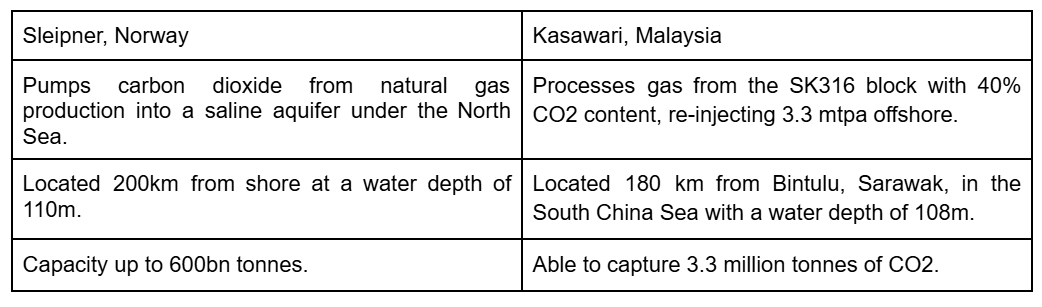
Carbon Capture, Utilization, and Storage (CCUS) has advanced from pioneering offshore projects like Sleipner in Norway to massive new ventures such as Malaysia’s Kasawari development. Sleipner, which began injecting CO2 in 1996, proved that offshore saline aquifer storage was technically feasible, providing decades of operational experience and extensive monitoring data.

Building on this foundation, Malaysia is attempting to commercialize CCS at a scale never before attempted, with Kasawari’s offshore platform designed to process and inject 3.3 million tonnes of CO2 annually from gas with 40% CO2 content. The project is four to five times larger than Sleipner’s, signaling both ambition and unprecedented technical challenges. Together with other announced CCS hubs, Malaysia is positioning itself as a regional leader in carbon storage despite the absence of a dedicated regulatory framework.

The table below shows the differences between the Sleipner project in Norway and the Kasawari project in Malaysia.

IEEFA has compared Sleipner to Malaysia’s CCUS hubs, which are larger by factors of 10 or more. As IEEFA states, “Every proposed project needs to budget and equip itself for contingencies both during and long after operations have ceased” (IEEFA, 2023).

Against this backdrop, Petronas, Malaysia’s national oil and gas company, approved the Kasawari project in November 2022. The project aims to inject 3.3 mtpa of CO₂ underground to monetize a subsea gas deposit with an unusually high CO₂ content of 40%  (IEEFA, 2023).

Located in the South China Sea, 180 km north of Bintulu, Sarawak, the Kasawari CCS project draws gas from the SK316 block, which contains an exceptionally high 40% CO2 content. This concentration creates an unprecedented challenge: stripping out, transporting, and storing such a vast volume of CO₂.

To address this, Kasawari’s RM4.5 billion (US$1 billion) CCS component will include the world’s largest offshore CO2 processing platform. With a planned injection capacity of 3.3 mtpa, it will rank among the largest projects globally, second only to Chevron’s underperforming Gorgon project in Australia, at 3.5 to 4 mtpa.

The scale of Kasawari makes system integrity, injection well performance, and storage reliability absolutely critical if long-term CO2 reduction goals are to be achieved. Yet Malaysia has not established CCS regulations, leaving projects of this magnitude to advance without a dedicated regulatory framework.

This lack of precedent is not unique to Malaysia. Globally, governments and industry are proposing CCS storage sites with capacities far beyond those of Sleipner and Snøhvit. The reality is that projects of the scale envisioned for the Houston Ship Channel, the UK CCS clusters, Norway’s Northern Lights, or Malaysia’s Kasawari have never before been attempted.

In this context, Petronas has opted for a Sleipner-like model, performing all gas processing and CO2 recompression offshore on a dedicated platform. However, unlike Sleipner, Kasawari’s platform and equipment will be four to five times larger, making it the world’s biggest dedicated CO2 processing facility.

The unprecedented size and complexity of Kasawari also extend to its contracting strategy. To manage the project’s unique conditions, massive scale, and the risks, both known and unknown, associated with start-up and commissioning, Petronas has adopted an “alliance contracting” risk-sharing structure with Malaysia Marine and Heavy Engineering. While this conservative approach provides a safeguard against unforeseen challenges, it will likely add to the cost of what is already an RM4.5 billion (US$1 billion) component of the overall development.

Malaysia has recently been pivoting itself as being amenable to CCUS facilities being built in the country. 

By late 2024, four landmark CCUS projects have been announced:

  • Petronas Carigali Kasawari-M1: Located offshore Sarawak, the project is scheduled to begin operations in 2026. It is proposed that 60% of the storage capacity will be allocated to Malaysia, for PETRONAS and its partners, with the remaining 40% made available to other users (NS Energy, 2023; Havercroft et al., 2024). 

  • PTTEP’s Lang Lebah-Golok: Located offshore Sarawak, the project is scheduled for operation in 2028. Identified as Malaysia’s second CCS project, the Lang Lebah field holds an estimated 5 trillion cubic feet of gas in place. Development will require the removal of both CO2 and hydrogen sulphide (H2S) (Battersby, 2022).

  • BIGST Cluster: Estimated to hold around 4 trillion cubic feet of recoverable gas. The cluster has remained undeveloped, however, due to its high CO2 content. Given its strategic role in Peninsular Malaysia’s energy security, development will hinge on carbon capture and storage (CCS), positioning it as the first CCS project in the region (Searancke, 2024; Petronas, 2022).

  • M3 Project: Located offshore Sarawak, East Malaysia. The project is designed to store CO₂ emissions from multiple industries in Japan, including those in the Setouchi region, through injection into offshore Sarawak reservoirs (Battersby, 2024).

According to Malaysia’s National Energy Transition Roadmap (NETR), the following CCUS-related targets have been stated. 

By 2030: 

  • Develop 3 CCUS hubs (2 in Peninsular Malaysia, 1 in Sarawak) with a total storage capacity up to 15 mTpa (15 million tonnes per annum, mTpa), about 300,000 barrels per day (bpd).

By 2050: 

  • Develop 3 carbon capture hubs with a total storage capacity between 40 to 80 mTpa.

A CCUS bill was planned to be tabled by November 2024, and was pushed forward a few months later. Malaysia’s Carbon Capture, Utilisation and Storage (CCUS) Bill 2025 has cleared both houses of Parliament and now awaits Royal Assent, with supporting regulations slated to come into force by March 2025 (The Edge Malaysia, 2025; Malaymail, 2025). Championed by Economy Minister Rafizi Ramli, who has positioned himself as the government’s lead architect on industrial decarbonisation, the bill is designed to unlock investment, regulate offshore CO₂ storage, and lay the groundwork for a carbon tax in 2026. Rafizi has argued that Malaysia cannot rely on reforestation alone and must instead leverage its vast depleted reservoirs and offshore capacity to host large-scale CO₂ storage. By providing a legal framework and clear incentives, the bill seeks to position Malaysia as a regional hub for CCUS, attract foreign investment, and generate new revenue streams through state taxes, port fees, and industrial partnerships.

Petronas is pressing ahead with its decarbonisation strategy following the passage of Malaysia’s CCUS Bill 2025, with the flagship Kasawari CCS project now in production and preparing to capture and inject up to 3.3 million tonnes of CO2 annually into the M1 field offshore Sarawak (Lee, 2025). To deliver this, Petronas awarded a RM4.5 billion EPCIC contract to Malaysia Marine and Heavy Engineering (MMHE) in August 2025 for the construction of the world’s largest offshore CO2 processing platform, located about 138 km from shore (The Edge Malaysia, 2022). The platform will be central to Malaysia’s ambition to become a regional CCUS hub, offering storage services beyond domestic demand.

Key findings: Sleipner demonstrated the technical viability of offshore storage but also highlighted the uncertainties of long-term containment, lessons that are highly relevant for Malaysia’s next-generation projects. Kasawari’s scale makes it a global test case for whether CCS can manage very high CO₂ concentrations and sustain multi-million-tonne annual injections. Yet, regulatory gaps, cost escalation risks, and system integrity concerns cast uncertainty over its long-term effectiveness. Malaysia’s broader CCUS roadmap shows strong ambition, but success will hinge on robust oversight and the ability to manage risks at scales far beyond what has been proven to date.

Editor’s Note: After losing the Parti Keadilan Rakyat (PKR) deputy presidency to Nurul Izzah Anwar in May 2025, Rafizi submitted his resignation as Economy Minister, effective 17 June 2025. Prior to his departure, he had already completed major tasks like the 13th Malaysia Plan. He is considered to be the key mover of the Bill, making CCUS a high priority.

Worth noting: The debate over CCUS in Malaysia was marked by a division between government-backed initiatives and civil society opposition. The government views CCUS as a key part of its National Energy Transition Roadmap, aiming to position Malaysia as a regional lead in carbon management and kick-starting lots of capital expenditure. State-owned energy company Petronas actively pursues offshore CCS projects, collaborating with international partners like ADNOC and Storegga to enhance CO2 storage capacity (The Edge Malaysia, 2022). But, environmental organizations and opposition lawmakers express significant concerns. Groups such as Greenpeace Malaysia and Sahabat Alam Malaysia (SAM) argue that the CCUS Bill was hastily passed without adequate public consultation, questioning its environmental and social implications (Greenpeace Malaysia, 2025). Furthermore, the Borneo states of Sarawak and Sabah have pushed back on the federal CCUS Bill, seeking more control over CCS projects within their territories.

In this series:

  • Part 1: Climate Mitigation and the Price of CCUS

  • Part 2: Case Studies

  • Part 3: Malaysia’s Big Ambitions 

  • Part 4: Issues for Successful Deployments

Reach us at khorreports[at]gmail.com